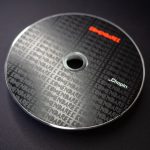


Despite many predictions, CDs continue to be widely used. They remain popular in music, film, and gaming industries. In this article, we’ll explain how CD replication works and why it’s still a smart choice today.
Interesting facts about CDs
Patented by Sony and Philips, CDs entered mainstream use in the 1980s, though research and development began over a decade earlier. The surface of a CD contains microscopic pits and lands—small indentations and flat areas that physically store data. These tiny variations represent binary code, where pits and lands function as 0s and the transitions between them signify 1s, allowing digital devices to read the information using a laser beam.
CDs consist of three main layers:
- A polycarbonate plastic base.
- A reflective metallic layer, usually aluminum, that reflects the laser beam.
- A protective acrylic or UV-hardened lacquer coating that shields the metal layer from dirt and damage.
Standard CDs have a diameter of 12 cm and a thickness of approximately 1.2 mm.
Types of CDs
Computer users are familiar with CD-ROMs, which have long been used for software distribution. These discs allow data to be read but not modified or erased. However, there are also three other main types of CDs:
- Audio-CD – Used exclusively for music distribution.
- CD-R – Sold as blank discs that can be written to once using a CD burner.
- CD-RW – Rewritable discs that allow data to be erased and rewritten multiple times.
CD pressing vs. copying (duplication)
CD pressing is a replication method that dates back to the vinyl record era when grooves were physically pressed into discs. A similar concept applies to CDs, where pits are physically imprinted onto the surface.
Duplication, on the other hand, involves burning data onto blank discs using a laser. While duplication is quick, the resulting CDs are more prone to damage, and the stored data typically lasts about 10 years. In contrast, pressed CDs have a significantly longer lifespan, greater durability, and are more cost-effective for large-scale production.
Modern CD pressing technologies – how the process works
Today’s advanced CD replication technologies ensure excellent data quality and long-lasting optical media. The process begins with the creation of a master disc. Data is first burned onto a glass master using precise laser etching. This master is then metalized and electroplated with nickel to create a negative mold from which all CDs are replicated.
The actual pressing process involves several steps:
- Mold preparation – The nickel mold is placed in an injection mold press designed to match the shape and dimensions of a CD.
- Polycarbonate injection – Heated polycarbonate is injected into the mold, imprinting the data from the master disc.
- Cooling process – The newly formed CDs are cooled to maintain their shape and prevent deformations.
- Metallic coating – A thin layer of aluminum is applied to ensure laser readability.
- Protective lacquer application – A UV-hardened lacquer layer is added to safeguard against scratches and damage.
The final step is an automated quality control check, where each disc is scanned to ensure data accuracy and defect-free production.
Custom printing on CDs
The non-data side of a CD can be customized with various designs using CD printing methods:
- Offset printing – Ideal for high-resolution, full-color images with CMYK processing.
- Screen printing – Best for solid colors and Pantone-matched designs.
Why choose professional CD pressing from Digi Pres?
If you’re planning mass production of optical media, pressing is the best choice. When you need more than 300 copies, pressing is the most economical choice. CD replication offers better durability, lower cost per disc, and professional results. Since 1990, Digi Pres has specialized in CD production, offering high-quality replication, custom printing, and packaging solutions.
Contact us today to learn more about our services. Let’s bring your music, software, or multimedia project to life with professional CD pressing!